Egg, Inc.
- 4.7
- Rating
- 10.00M
- Installs
- Free
- Price

 Analysis by App-foxy
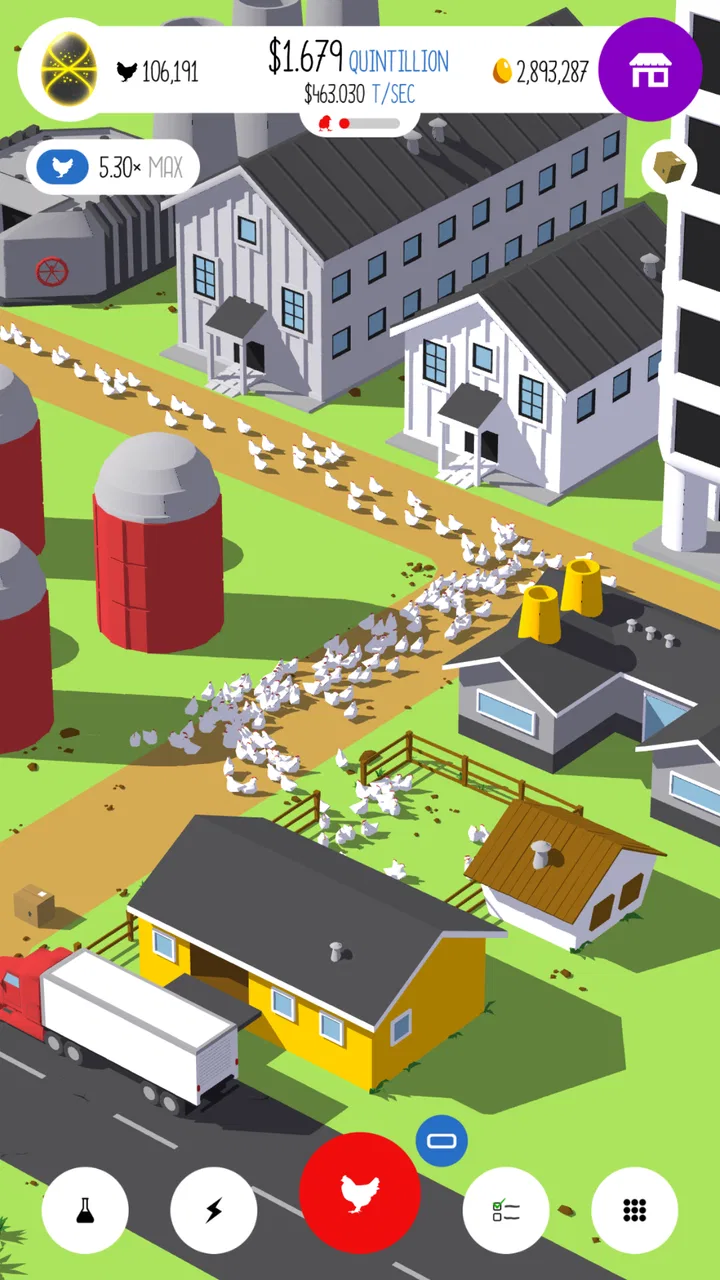
I approached Egg, Inc. expecting a simple farming game, but its appeal is more patient than that. You begin with a small egg operation and gradually turn it into a much larger business while working through a light science-fiction theme about production, expansion, and the universe beyond the farm. It is a simulation game from Auxbrain Inc., free to start, and it works best when you enjoy checking progress, making small upgrades, and deciding when to reset your momentum for a stronger future run.
My first impression was that it is easy to understand but not necessarily effortless to use well. The opening actions are clear, yet the game becomes more interesting when several upgrades compete for attention. Should I improve the number of chickens, increase shipping, expand housing, or strengthen research? Those choices are not difficult in isolation, but they create the rhythm that keeps the farm moving. I found myself returning for short sessions rather than sitting down for one long play period.
The game has a 4.7 average from around 1.4 million ratings, with more than 10 million installs. Those figures fit my experience: it is broadly approachable, but its slow-burn structure is more specific than the cheerful presentation first suggests. It is rated Everyone, so the tone is suitable for a wide audience, although younger players may still need guidance around optional purchases.
You May Also Like

 Blood Strike: 2.5 Anniversary
Blood Strike’s Loadouts Turn Every Drop Into a Tactical Gamble
A close look at Blood Strike’s custom loadouts: how fast access to signature weapons reshapes its battle royale rhythm, rewards preparation, and narrows the gap between fights.

 Pandora - Music & Podcasts
Pandora’s Music Is Easy to Start, but Harder to Recover
Pandora’s strength is its low-effort path from a seed to a station. Its weak spot is how much confidence it asks you to place in connection, setup, and quiet recovery.

 8 Ball Pool
 Is Built on Rivalries, Rematches, and Routine
A close look at the rivalries, rematches, shared routines, and unanswered safety questions that turn a quick pool match into a persistent mobile community.

 Samsung Music
’s Quiet Strength Is Playing What You Already Own
Its reach comes less from spectacle than from dependable access to a personal library. That simplicity is both the app’s strongest retention engine and its ceiling.

 AccuWeather: Weather Radar
AccuWeather Review: A Quick, Clear Forecast for Everyday Decisions
For everyday plans, the best forecast is the one you can understand quickly. AccuWeather makes rain timing, radar, and local conditions easy to act on, with a few trade-offs.

 Hill Climb Racing
Why Hill Climb Racing Still Turns Crashes Into One More Run
A tiny car, a bumpy hill and one more upgrade: Hill Climb Racing keeps resurfacing because its simple chaos makes every near-miss feel personal.
More From Our News Desk



Where players usually get stuck
The most common point of friction is not learning how to tap or collect. It is understanding what deserves attention when the farm starts producing more quickly. Early progress can make every upgrade look useful, and spending resources as soon as they appear feels natural. I got better results when I stopped treating each purchase as an immediate reward and instead asked which improvement would remove the next bottleneck.
That bottleneck can move. A farm may have enough chickens but not enough housing. Housing may be available while shipping cannot keep up. Production can then look disappointing even though the problem is not the chickens themselves. This is one of the practical lessons of the game: when growth stalls, inspect the whole chain before assuming that a single upgrade is missing.
The interface also encourages quick decisions, which is convenient but can make a hurried session less efficient. If I opened the game while distracted, I was more likely to spend currency on whatever button was most visible instead of checking the longer-term effect. A short pause before upgrading made a noticeable difference to how smoothly a run developed.
Another sticking point is the pace. This is not a conventional action game with constant manual challenges. Much of the satisfaction comes from watching numbers rise, returning later, and preparing the next stage. Anyone expecting a fast arcade experience may interpret the waiting and repetition as a lack of content. I see it differently, but only if the player genuinely likes incremental progress.
The reset-style progression can also feel confusing at first. Starting over may sound like losing work, yet the point is to exchange a completed run for stronger future growth. I recommend treating the first few attempts as experiments. Notice how far the farm gets, which upgrades mattered most, and whether the next run feels faster. That mindset makes the loop easier to appreciate than trying to protect every bit of short-term progress.
Small setup checks before blaming the game
Because the game is designed around repeated visits, I would begin with simple checks if something feels wrong. I first make sure the device is running a supported version of the operating system; the listed minimum is Android 7.0. I also check that the game has finished updating through the relevant app store and that the device has enough free space for ordinary app operation.
If progress appears not to move, I leave the current screen and reopen the game rather than repeatedly tapping the same control. I also check whether the device is in a restricted battery mode or has a weak connection when an online-dependent action seems delayed. These are general troubleshooting steps, but they matter here because the game is built around returning to an evolving farm rather than completing everything in one uninterrupted session.
I would avoid clearing app storage as a first response. That is a much more disruptive step than closing and reopening the game, and it can create unnecessary risk for local progress. Restarting the device, installing the current version, and checking the connection are safer first moves. The current version listed for the game is 1.37.2, so keeping the installation current is sensible when a problem appears after a long period without updates.
Notifications and background behavior can also affect expectations. If I return and see less progress than I imagined, I consider whether the game was actually open, whether the device had restricted background activity, and whether the relevant production cycle had enough capacity to continue. It is easy to assume that every part of the farm grows without limits, but the simulation still depends on the upgrades and constraints visible in the game.
For a child using the game, I would also review purchase controls before handing over the device. The download is free, while optional in-app items are listed from $3.99 to $19.99 each. That does not make the game unsuitable for families, but it does make device-level purchase protection worthwhile, especially because the bright upgrade loop can encourage “just one more” spending decisions.
Recovering a stalled farm without wasting a run
When my farm slowed down, I found it more useful to diagnose the production path than to restart immediately. I checked whether the chicken population was actually filling available housing, whether the egg output had a place to go, and whether research would improve the current stage or merely look attractive. This simple order prevented me from pouring resources into a part of the chain that was not limiting progress.
A useful workflow is to collect what is available, inspect the weakest capacity, and then make one meaningful upgrade before waiting again. Buying several unrelated improvements at once makes it harder to tell what helped. One change at a time is slower emotionally, but it gives a clearer sense of how the farm works and makes the next decision less random.
I also learned not to judge a run by its opening minutes. Early upgrades can feel powerful, then their effect becomes less dramatic as costs rise. That is not necessarily a malfunction. It is a signal to reconsider the order of investment and, eventually, whether continuing the current run is still the best use of time. The game rewards planning around momentum rather than chasing the biggest number on the screen.
For everyday use, I like a short-session routine. I open the game during a break, collect earnings, check the main constraint, make a planned purchase, and close it again. This is more comfortable than leaving it open constantly, and it keeps the game from taking over the day. It also suits people who want a simulation they can revisit without needing a long uninterrupted appointment.
If a run feels weak, I do not immediately assume the account or installation is broken. I compare the current farm with my own previous decisions. Did I spend too early? Did I neglect capacity? Did I continue a run after its useful momentum had faded? Those questions often explain the result better than a technical fault. The game’s design makes inefficient choices look like slow progress, which is part of its learning curve.
The reset decision deserves special care. I would choose it when the current run has become expensive to advance and the permanent benefit of beginning again is more attractive than squeezing out a little additional short-term production. The exact best moment depends on how you have developed the farm, so I prefer using the first runs to learn the relationship between effort and future speed instead of following a rigid rule.
When the app is not the cause
Some frustrations come from expectations rather than software. If you want direct control over every worker, vehicle, or building, this may feel too abstract. The game presents a farm-management fantasy, but the interaction is streamlined around upgrades and progression. A more detailed management simulator would be a better match for someone who wants complex scheduling, staff behavior, or hands-on construction.
It is also not the ideal choice for someone who dislikes idle-style pacing. Even though decisions matter, much of the experience involves waiting for production and returning to improve the next cycle. A puzzle game may be more satisfying if you want a fresh problem every minute, while a traditional strategy game may suit you better if you want battles, maps, or direct competition.
Connection problems can be misleading as well. If a particular screen or optional action does not respond, I check the network before concluding that the whole installation is faulty. On the other hand, if the rest of the device is working normally and the same issue survives a restart and update, then it becomes reasonable to treat the problem as game-specific rather than blaming the phone.
Device performance matters in a less obvious way. A phone that is nearly full, heavily restricted in the background, or running many demanding apps may make any progression game feel unreliable. Closing unnecessary apps and freeing some storage are sensible general steps. I would not jump straight to reinstalling, especially if I had not first considered how progress is being stored and whether I could safely recover it.
The purchase model is another reason to be selective. I enjoyed the free starting point, but players who are sensitive to upgrade pressure should decide in advance whether they will spend anything. The game is more comfortable when optional purchases remain optional in your own routine. If the temptation to accelerate every slow period removes the satisfaction of planning, the free structure may stop feeling relaxing.
Compared with simpler clickers, Egg, Inc. gives the growth loop more shape through its farm theme and the need to balance several parts of production. Compared with deep simulation games, it is much lighter and easier to pick up. That middle position is its strength for casual players, but also its limitation for experts seeking granular control. I would choose it for accessible progression, not for a full agricultural management model.
Who will enjoy the long-term loop
I recommend it to players who like visible progress, gentle optimization, and games that fit around real life. It is especially suitable when you want something to check during short breaks, because a session does not require a complicated setup each time. The cheerful egg-farm setting also gives the numbers enough personality to feel less sterile than a purely abstract incremental game.
It can work well for families because the age rating is Everyone and the basic idea is easy to explain. Still, I would supervise spending and help younger players understand that waiting is part of the design rather than a problem that must be solved with a purchase. That conversation is useful because the game’s most important skill is patience with choices, not rapid tapping.
I would skip it if you need a clear ending every time you play, dislike repeating a progression cycle, or want deep control over a simulated economy. I would also be cautious if you are likely to spend impulsively when progress slows. The free entry is welcoming, but the optional items mean that personal boundaries matter more than the download price alone.
Auxbrain Inc. has built a game that looks simple enough for anyone to try while leaving room for players to improve their decision-making. The challenge is not hidden behind complicated controls; it is in recognizing which limitation is holding the farm back and when a fresh run will be more productive than forcing the current one.
My practical verdict after living with the farm
Egg, Inc. is a polished choice for relaxed simulation gameplay with an incremental structure. I like that it can be played in small visits, that the farm gives the numbers a memorable setting, and that the reset loop gradually turns early mistakes into useful knowledge. My strongest advice is to upgrade with a purpose, inspect the entire production chain when progress slows, and treat restarts as part of the strategy rather than as failure.
The friction is real: the pace can be repetitive, capacity limits are not always obvious to a new player, and optional purchases may not suit everyone. Technical-looking problems can also come from battery restrictions, outdated software, weak connectivity, or unrealistic expectations about background progress. Simple checks should come before drastic actions, and clearing storage should never be the first troubleshooting move.
With those conditions in mind, I think the game earns its strong reputation. It is free to try, suitable for Everyone, and currently listed at version 1.37.2, with a release history reaching back to July 13, 2016. I would recommend it to a friend who wants a calm, repeatable farm-building game rather than a demanding strategy challenge. The best reason to play is the satisfying decision loop, not constant action.
My final recommendation is straightforward: install it if watching a small operation become enormous sounds rewarding and you enjoy making gradual improvements. Keep spending controls in place, give the progression time to breathe, and do not confuse a deliberate pace with a broken game. If you want detailed agricultural realism or nonstop interaction, choose another kind of simulator; if you want an approachable long-term idle experience with more structure than a basic tapper, this one is a very good fit.
FAQs for Egg, Inc.
01What is Egg, Inc. and how do you play it?
Egg, Inc. is an incremental farming and business simulation game in which you build and manage a futuristic egg farm. You begin with a small operation, then purchase hen houses, shipping vehicles, research upgrades, and automated systems to increase production. The main gameplay loop involves tapping to generate cash, reinvesting earnings, completing contracts, and unlocking increasingly valuable egg types and farm technologies.
02Is Egg, Inc. free to download and play?
Yes, Egg, Inc. is free to download on supported Android and iOS devices. The game can be played without paying, and normal progress is possible by actively managing your farm and using earned resources. However, it includes optional in-app purchases, which may provide premium currency, boosts, or convenience features. Players should review the store settings if they want to prevent accidental purchases.
03Does Egg, Inc. require an internet connection?
Egg, Inc. can generally be played offline for many of its core farming and upgrading activities, making it suitable for short sessions without mobile data. Some features, including synchronization, advertisements, contracts, leaderboards, cloud-related functions, or certain event content, may require an internet connection. Availability can vary by device and game version, so online access is recommended for the complete experience.
04Are there advertisements or in-app purchases in Egg, Inc.?
Egg, Inc. contains optional advertisements and in-app purchases. Advertisements may be offered in exchange for useful rewards, such as temporary boosts or additional resources, rather than always appearing as forced interruptions. Purchases can speed up progress or provide premium items, but they are not strictly required to enjoy the main game. The overall design still encourages frequent reinvestment and repeated play.
05Is Egg, Inc. suitable for children and casual players?
Egg, Inc. is easy to understand and does not require complex controls, so it can be approachable for casual players. Its colorful presentation and simple tapping mechanics may also appeal to younger audiences. Nevertheless, parents should be aware of optional purchases, advertisements, and online features. The game becomes increasingly focused on optimization, waiting, and long-term progression, which may not suit players seeking a fast-paced experience.
Pros
- Relaxing idle gameplay that is easy to understand and start playing.
- Many farm upgrades and missions provide clear short-term goals.
- Offline earnings let progress continue when the app is closed.
- Distinct egg types and habitats add variety to the production system.
- Events and contracts offer extra challenges beyond the main farm.
Cons
- Frequent upgrades can become expensive and encourage long waiting periods.
- Some progress is strongly tied to watching ads or using premium currency.
- The interface may feel crowded once multiple habitats and machines are unlocked.
- Late-game progression can become repetitive without regular events.
- Large farms may drain battery during extended active play sessions.

Egg, Inc.
Gallery